This is the first commentary I am writing so this is a foreword giving a rough guide to the route this essay may take. As is vital with any summary of a short story, at first there must be a short round up of the story at hand. Then various aspects are picked up along the way of a more detailed description and characters, arguments and observations handled simultaneously.
The primary characters in the story are Mrs. Kinsolving, her twenty nine year old son Terence, the matron Mrs. Bellamy Bellmore and Mrs. Fischer-Suympkins. In most of O Henry’s short stories there is a minimal detail of the characters’ background rather the focus is on the development of the character’s influence We are directly introduced to a conversation between Mrs. Kinsolving and Mrs. Bellmore discussing a ghost that was seen by Mrs. Fischer-Suympkins. There was a degree of shock that the ghost of a member of an honourable family may be carrying a hod. The ghost of an old man in overalls, smoking a pipe and carrying a hod. Mrs. Kinsolving is convinced that Mrs. Fischer had malicious intents in circulating this story. The very fact that he was carrying a hod was so appalling to her that there was a rather long discussion with Mrs Bellmore on this.
“But she told everybody!” mourned Mrs. Kinsolving, inconsolable.
O Henry had the ability to bring out his character’s emotions to the fore in the simplest of ways and in such a way that one could feel the anguish or the joy that the character would be feeling. In a family of stature as the one in the story, social reputation is of great importance. The Kinsolvings have been described in various dialogues as a family who had “revolutionary ancestors” with one Captain Kinsolving who fought in General Greene’s army. Rumours of a family ghost carrying a masonry hod would have a dire impact on the reputation of the family ancestors and therefore on the family itself. This was a matter of great concern to Mrs. Kinsolving. One must not forget that the story is based in America and not in England so the customs and social behaviour differ quite distinctly.
In the story we have only one instance when a character description has been give. That is of Mrs. Fischer-Suympkins She was a rather flamboyant personality “the heliograph of the smart society parading corps”. She was the queen on peep-show. But middle age had caught up with her and her wit developed a sting; her manners became more rough and inconsiderate. She had been forced to grace the Kinsolvings with her presence and was not fond of it. She had her revenge when to Mrs. Kinsolving’s, her hostess, utter shock and dismay she narrated the tale of the family ghost with a hod. She enjoyed such moments.
Mrs. Bellmore’s presence served a two fold purpose. She was a young matron of wealthy descent and beautiful. Mrs. Kinsolving was also hoping that her presence would please her shy son. Mrs. Bellmore though was decided in that particular aspect. Her conclusion of Terence was that either his less talkative nature was due to shyness or depth in character. In both cases, she would abandon him as shyness was a bore while depth precarious.
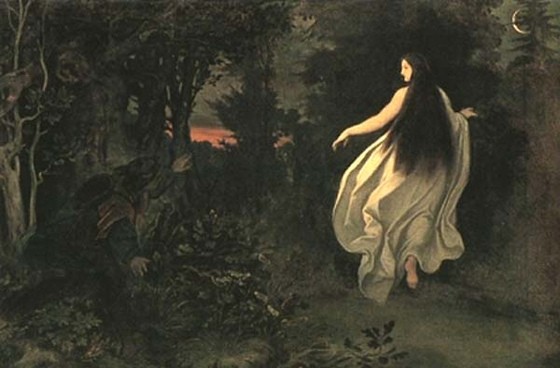
On the third day of her visit, Terence sought her out and they discussed the possibilities of her seeing a family ghost. Indeed, next morning Mrs. Bellmore told everyone of the appearance of a ghost dressed in all white the previous night while she slept. Her story merely described the appearance of a shadowy white figure then its disappearance after a while. Most dismissed it as a cooked up story and offered a nod of acceptance while some believed every word she spoke and trusted her facial lines to be of one who was speaking nothing but the truth. But it was to Terence that she revealed a startling occurrence from the previous night-
“Then, why,” said Mrs. Bellmore, looking the young man gravely in the eye, “should the ghost have kissed me, as I’m sure it did?”
By this time, the reader is quite taken aback at the nature of ghosts in this story. First, a respectable family ghost walks around with a hod and now of all things that a ghost could do, it kisses a matron. Also, the reference to the ghost with the impersonal pronoun is a point of small debate between Terence and her, undecided whether to refer to an apparition with a pronoun that depicted gender or simply an object. Terence shows mild surprise but great curiosity towards the sensation experienced by Mrs. Bellmore. O Henry was an expert in keeping his ending under wraps till the time he wished until he would suddenly fling upon the reader a startling revelation. Just as Mrs. Bellmore was leaving we are told that Terence was wrapping up boxes of costumes. The same one that Mrs. Bellmore had described upon the ghost. The shy lad had gone to the extents to dressing up as a family ghost to steal a kiss on the pretty matron. But there was still another twist. Mrs. Bellmore had salvaged from her bedroom a handkerchief with Terence’s initials. So she knew.
Like many of his stories. O Henry focuses and relies primarily on coincidence and contrived circumstance. One never knew if Mrs. Fischer-Suympkins’ version of the ghost was accurate or it was just a figment of her imagination to cause distress to her host. She has been described to have had a sardonic nature towards people whom she did not consider to be of her calibre of way of thinking. As she was quite forcefully made to accept the invitation to the Kinsolvings’ she might as well have construed a story that she knew would put her hostess in an embarrassing situation as well as her palate for wry humour would be satiated. Nonetheless, it was the narration of this tale that gave Terence the encouragement to go ahead with his plan of dressing up as an apparition and hence steal a kiss on an infatuation. Shyness is such a wonder.
Terence chose a previously mentioned family member, Captain Kinsolving to enact as a ghost. The choice is very apparent to the reader as he would want Mrs. Bellmore to tell the host family of a sight that they could relate and everyone could believe the story with ease thereby keeping his act obscure. But it his character that is of interest. One thing is evident. He is simply shy. Mrs. Bellmore’s assumption that he may be deep can be ruled out under the present circumstances. But it would be unfair to judge a person so one may say. Although in a short story, our dealing with a character is restricted to the actions he performs rather than those he could have. The author once again leaves a contrived circumstance we may say to conclude on Terence. With soft words he convinces Mrs. Bellmore to sleep in the room where the ghost had been first told to have been sighted so that her mind is prepared to see a wavy indistinct apparition in the middle of the night. A shy person does not mean he’s without thinking and planning. Since he does not thrive on spontaneous interaction he would naturally rely on a planned scheme of events. Mrs. Bellmore is then shown an album of pictures of the family ancestors so an image of some kind is planted in her head so she can describe the chance happening at breakfast down to the last detail even though she was laden with sleep. Finally, the simple act of dressing up as Captain Kinsolving, planting a soft kiss and scampering away. One would liken this behaviour to that of an inquisitive teenager. But a twenty nine year old man enacting such a staged plan is surprising and offers no sympathy for the character but only a mocking cackle as his ruse is found out by the matron.
Although, Mrs. Bellamy’s description of the ghost and her telling of the subsequent reactions do cast a doubt whether she knew it was not a ghost at that very instant in the night or did Terence’s handkerchief give it away.
“I suppose I ought to be ashamed to confess that I wasn’t very much disturbed.”
The natural reaction to seeing a ghost would be to give the shrillest of shrieks and bring the house down unless the person is drugged or simple too lazy to wave the ghost away and let the restless family member do his night patrol. Mrs. Bellmore’s reaction was that of the latter. It did not convince most people that she had seen a ghost as her narrative lacked a dramatic touch but was simply a drab narration of one who has memorised a play. Either she already knew when she cornered Terence and enquired about the strange kiss or it was genuine wonder. The author leaves us to speculate with no end to the discussion. Classic O Henry. Finally, the ending where we are told that Mrs. Bellmore knew what had happened and she clearly disapproved of it.
It was a month later when Mrs. Bellmore and one or two others of the smart crowd were making up a list of names for a coaching trip through the Catskills. Mrs. Bellmore looked over the list for a final censoring. The name of Terence Kinsolving was there. Mrs. Bellmore ran her prohibitive pencil lightly through the name. “Too shy!’ she murmured sweetly, in explanation.


Leave a comment