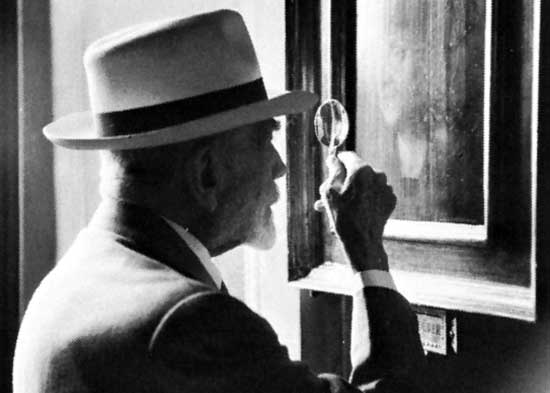
“Inadequate,” remarked Mr. McCarthy, a look of disdain on his erudite face.
“I would disagree. I like this poem. I see those flamboyant words I read in the Dickens novel recently. Certainly I feel Mr. Potts is a good writer. Albert, I say, this is wonderful,” Mrs. McCarthy shot back in embarrassment at her husband’s usual reproach.
“Martha,” uttered the elderly critic and his wife fell silent. “Mr. Potts, I felt the first impression upon reading your work is of genuine delight. But a trained eye would see a plethora of minor errors which would make a critic at work chafed. Since this has been a pleasant evening I shall not speak further. My word upon your work thus remains: inadequate.”
Albert Potts looked wry. His wife was not pleased. She did not expect the elderly man to be so rash. “Thank you Sir for gracing us with your presence. We’ll look forward to you visiting us again,” Mrs. Potts offered the customary greetings and with a dry face showed the McCarthys to the door. One might have even noticed her give an indignant look at Martha. Albert though held a subdued pose yet his ego kept him from letting any animosity come to his face.
“Thank you Celia,” muttered Martha and offered an apologetic look at the Potts as they got up to leave. Her husband though offered no such sentiments as he made his way to the door with as much swiftness and relief as a student from his headmaster’s office.
“Why did you need to be so petulant with Albert’s work? Celia is a good friend of mine and you completely embarrassed me today. She invited me with a certain gusto as she believed you getting along well with Albert as you share common interests would have been a delightful evening. You certainly ruined it William,” Martha spoke angrily as they sat in the cab on their way back.
“It was not good. It is my work as a critic to point out what lacks in a work of literature. It is not a gag Martha. Literature is serious and I will not praise any work laid out before me that has been finished with a lackadaisical approach.”
“At the cost of social disgrace? We only have a few friends.” Mrs. McCarthy spoke with a hint of pain in her voice. Due to her husband’s reluctance to waste time in idle conversation and social gatherings many of her friends had come to treat them with contempt.
“People mean nothing to me. I have literature and I have you.” William McCarthy put his arm around his wife and spoke with a finality in his tone such that they did not speak another word that night.
William McCarthy was a well known personality in his field of work. Over the years of being a scholar and a critic, he had a reputation of one of the best critics but also the most unforgiving one. There have been many a writer who have shuddered in their bath robe after a hot shower as the critic’s words still rang in their head from the previous week’s critique in the literary journal. He was the Theodore Roosevelt of critics. Principled, firm and he never let anyone off with leniency unless he was as perfect as John Keats. He idolized Keats. The irony being he made his name when he attacked a Keats poem with such ferocity that he impressed the entire university and the seniors thought the young man would be instrumental in the growth of modern poetry; mistaking his criticism as one of a man with a modern mindset. It turned out to be a fatal miscalculation. For the next thirty years, he set a benchmark for critiquing literature with the traditional set forms as the weighing scales. The senior who had noticed him and brought him up the ranks still turned in his grave in apparent discomfort as scores of writers each year would the curse the man who “gave this senile critic his running shoes”. William McCarthy though never faltered in the face of criticism as he felt his criticism was enough to knock people off boats and by the time they would clamber back on, he would have forgotten them. But those few fortunate ones who earned a good review from him made it big in the field. Publishers would take his critique very seriously in committing themselves to any writer. That pleased the exceptional ones but the mediocre ones simply declared the age as William McCarthy’s hegemony in the world of English literature.
Socially, William was a misfit. It was not due to his career or any prejudice from people because of his nature of work. Since he was a child, he never liked the idea of talking to his parent’s friends or their children. He would usually be found sitting in a corner mumbling words to himself. He would sing himself songs, watch people with a contemptuous expression on his face and simply walk away if someone attempted to strike a conversation with him. His parents often reprimanded him for this but he was not a child who would change his ways. He fell in love in with Martha at his graduation ball in his university. She was the first person he ever spoke to in a social gathering of his own accord. A stranger to the hormonal barriers one faces when approaching a lady since he was a stranger to the whole custom of speaking to people anyway, he possessed such confidence and charm that he won her heart in a moment and her hand over the next six weeks by which she wore a magnificent sapphire ring on her finger. To the rest he remained as snobbish as ever. Some speculated that he hid a dark character while some just found him rude and did not bother to retrace their steps back towards him. Thus he had a few friends, all colleagues. He was content.
Martha loved her husband. She reiterated many times she could not imagine living without him. To her friends she would talk gaily about him with a chirrup in her voice that rung throughout the conversation. She would grow enthusiastic when she would tell how proud she is to be married to a man who lived his life on his own accord and she would tell about how he won her over. It was a most romantic tale. But over her narration there would come a point where she would grow tremulous. It was different to when she would express her dismay over his social behaviour. It was as if that she knew something about him that a was a great burden to her. She would quiver and eventually falter. When a large group of women get together for an evening of chatter, they are always too eager to tell their own tales with fervour and wherever there is a hushed whisper or a loud laugh, heads turn towards that direction. Martha would fizzle out slowly from her narration and soon would become inconspicuous. She would sulk for a while but then a delicious cake would put her in loftier spirits and the chatter would continue. On occasions such as the catastrophe at the Potts’, she would be dejected for the night but the next day she would put that out of her mind and at the usual seven o’clock get up and make her husband a cup of tea. She loved William. But the day afterwards the visit to the Potts’ she got up with a tremble that stayed till her husband woke up.
“William, there is a mail for you. Also, Harry wrote to us. He’s worried about Frederick. He’s still in the hospital. The poor child has suffered a lot.” spoke Martha as she sat across him with her tea.
Mr. McCarthy folded the newspaper, took a sip of his tea and gave his wife a searching look. “I don’t know dear, should we pay him a visit this week? It would be a generous gesture I feel.”
William had an affection for his younger brother Harry and took interest in his son as he did not have a child of his own due to Martha’s inability to bear a child. He was secretly thankful. It saved him the effort to convince Martha that he did not want children. He knew that it could cost his marriage. At times, he did despise himself but had learnt to live with his shortcomings.
“Why don’t you write him a poem? You spend your entire days with them. Surely you can write the child one. He’ll be very happy.” Martha suggested hoping she would not have to spend too long convincing her husband.
“I guess I can do that. I do feel grieved by Fred’s ailment. He’s my only nephew after all.”
Martha was glad that William agreed so easily and did not disturb her husband for the rest of the breakfast before adding “We go in four days. Try to write that poem dear.” She kissed him softly on his creased forehead and walked to the kitchen.
That evening after a sumptuous supper and two glasses of wine, William retreated to his study to do something that he had never done before: write poetry. He poured himself a glass of scotch and faced the proposition. His whole life he had studied intently the dynamics and structures of verses piled upon one another but not for once had he tried to write a lonely quatrain. Life had simple ways of teaching new things, he mused. He remembered Ulfric, a character from one of his much loved novels he had read in his childhood. Ulfric was a recluse and was making his name in town as a painter. But soon the town was struck with a crisis and Ulfric stepped ahead with a rifle in his hands and shot down the mayor. He took control over the town and brought peace. It was a fantasy but he learnt that anyone could excel at something he had never done before because there is no fear of imminent failure, no doubt arising from previous failures as he had never done it before. He goes into battle armed with nothing but sheer confidence and he if he has the inborn talent that he had never unearthed, he excels. He defeats every one because he is the dark horse. Armed with this notion, Mr. McCarthy lifted his fountain pen and wrote the first two lines on an empty parchment and immediately cut them out.
He was faced with the greatest challenge in his life. For years immemorial, he had assailed other’s works with ferocity. Now he faced the ultimate question, should he critique his own work? His mind was now trained to analyse every rhyme he saw, every verse he saw and so the moment he put his words on the paper his mind told him that it was purely pathetic. William had always loathed children’s books but everything around him was changing this very instant. During the third glass of his favourite scotch he saw something strange, a blurry soporific figure: Patrick, his imaginary childhood companion whom he had ruthlessly abandoned at a playground when he was five was sitting next to him. For a while, William gazed at the caricature projected by his mind; Patrick had aged. He was dressed in the exact same attire that William had cursed him to be wearing should they cross paths again; Patrick was a bank officer dressed in a shabby suit. William as a child hated people and a part of his mind kept telling him to be more open to the world. He hated that part, he hated the name Patrick. Today, when he was about to open himself to the world, Patrick was back.
“Surely, old friend, you would not tamper your gift to the little child with the corruption of a critic’s mind, will you?” Patrick spoke softly with a hint of reproach in his voice. “You have no thought of feelings do you? A poem is just not a work of art William that needs a critic’s opinion. The critic should be grateful to the poets of old who wrote such masterpieces that critics were born to explain them to the world. What great joy have you brought to the world. Ask yourself: have you ever made anyone smile? Will you yet again keep yourself and the little child from smiling by your affliction to your work?”
It was true, he thought. Not once he had given a word to an artist that had lit up his face. His entire life he had seen artists crumble like summer time glaciers in the face of his words and it had given him pleasure. At times, he felt grim about himself but he convinced himself that he would improve the artists of the world by pushing them to the edge. His life was dedicated to the finding of faults. Such was his disease that he often forgot that art is meant to express the beauty of existence, that a sorrowful face could be expressed with emotion and the beauty could yet be expressed for we as humans for our existence must at all times look for happiness and light even when trapped in the darkest cavern. Art is such an expression that gives hope to men, strength to women and a bright smile to a child. He neglected all these facts and devoted his life to finding the basest of faults in the most complicated works. It filled him with a sense of superiority to be able to quash the morale of a brimming man. The ultimate success of an art was the failure of the critic, he believed. He knew that no work of art is perfect and he sought to find out the imperfection even if it hid behind the most beautifully crafted lines. It did make the ones who were very devoted to their work put more effort and become better writers but no one approached him with a sense of expectant elation or expressed excitement when they knew William McCarthy was going through their work. Some were fearful of him while the rest held contempt for him. Only a select few revered and respected him; those who were at the pinnacle of the art world and no critic could in any way soil there reputation and held less acclaimed writers with a kind of contempt that the Lords held for the common men.
“But Patrick, my whole life I have adhered to the norms and forms stated by the great writers of old. I know they did not write a rule book but it is by their works that our benchmark for literary excellence is set. I have sought for perfection in every artist’s work and not to adhere to my principle would be a grave disregard of my own philosophy.” William drew a slow breath, put his head in his hands and said.
“You have failed to understand art then,” the voices of a thousand people over thirty years spoke through Patrick. “Art is not science William. To get a bottle of hydrochloric acid such that you could melt your sworn enemy’s face you must get the formula right. But to tamper someone’s soul you need not have only one way. Forty years of living in the library hasn’t taught you that?”
“I know there are various ways to express emotions and that’s what makes us human; the ability to express oneself differently and that gives us our identities. When you walk into a garden you can tell which rose is the most fresh one and which one shall not survive the day. In the same way, our expressions represent us. When you speak with a man who is about to kill oneself, you feel that eerie vibe emanating from his being that fills you with discomfort and you feel life is at its end. You try to console him and convince him to not go ahead with his task not because you care about him, not always, but the from moment you come in touch with him till the moment he leaves you, a fragment of your soul leaves you for him in pity. Whenever you bear pity or sympathy towards another being, it is so because the soul cannot handle the strong vibes of regression and therefore surrenders a part of itself to the atmosphere so it may fool the predatory negativity and shield itself from the uncanny surrounding. Art depicts all these phenomena of the soul that science cannot explain to a common man. A common man cares not much for atoms and molecules but he does care for art. It is this reason that I seek perfection in art because it is of much greater significance to society than my own smile forced through my muscles or my mannerisms polished by a non existent need. The perfect balance in art. Sadly, I’ve identified it Patrick. I know the exact amount by which each ingredient in any form of literary art should be present. Now I cannot proceed without the lessons learnt in decades to write a simple poem for a seven year old child.” William having said that let a few drops of tears slide down his ivory cheeks through the deep crevices of age and onto the fresh sheet of parchment gracing it with sixty five years of pride and prejudice.
“Try William. Set free the shackles within which you bind art and yourself. Sometimes, it’s not necessary for the art to be perfect to spread joy but simply to be present.”
William turned to Patrick but he was gone. He felt it too, the contempt had diminished. He mused over the circus men that his mother took him to watch when he was young, the beautiful girls in his school he never infatuated on but instead despised them for being querulous, the ducks he sat by near the lake in his later teens and on the bright young students whom he dealt with an iron fist in his days as a professor. He looked for inspiration in everything he once was in disapproval of. In a moment of revelation it dawned upon him that he had ignored everything beautiful in this world except love and then he realized how much woe he had caused Martha by being snobbish towards the beauty of the world around. He never travelled with her or took her to the fair. A woman is already devastated when she comes to know that she cannot bear a child and he did not do much to console her instead he revelled in her misfortune in the light of his own selfish endeavours. He came to understand how much Martha loved him such that she had sacrificed all her joys to see the man she loved attempt to smile through walls of scorn and disdain that he had himself built. He may have won her heart but it was she who kept his in her palm and nestled it with love and care.
For the first time in his life, William’s face lit up with a smile that shone through the tears of enlightenment all the way to his bedchamber where his wife slept and lost in her dreams her face shone with a joy that a woman deserved. He wrote the necessary eight lines on a fresh sheet and did not look back to examine the metres or the intricacy of word play or rather the absence of it.
The next day, he was the first one up and brought a tray of a failed cup of tea and a half burnt toast to his wife in her bed and woke her up with a soft peck on her forehead.
“This is the best I could manage Martha. I have finally learnt to enjoy failure,” he said with an elderly grin. His wife got up and without a word gave him a warm embrace. They sat in the yard with their breakfast and after forty years of marriage for the first time had idle conversation.
Over the next three days William helped Martha with her household chores and left the stoic critic in him only for the university. He also took Martha to a play where they sat hand in hand. Martha was exceptionally affectionate and insisted they visit the Potts. He agreed instantly. Although they were given a cold reception, by the time they left Albert Potts remarked, “What a man Celia. Such men live once in many centuries.”
On the fourth day, they visited Frederick. William had added another four lines to the previous eight. His father read him the poem; a child does not know the significance of poetry but he does know the significance of a present. Fred gave his uncle a hug and William took that with him to his death bed with utmost adoration and joy.
To this day, among the closed despised world of critics and poets alike, William McCarthy’s poem to his nephew Frederick was held in high esteem not because it was perfect but because it was one of the most imperfect yet most beautiful poems ever.


Leave a comment